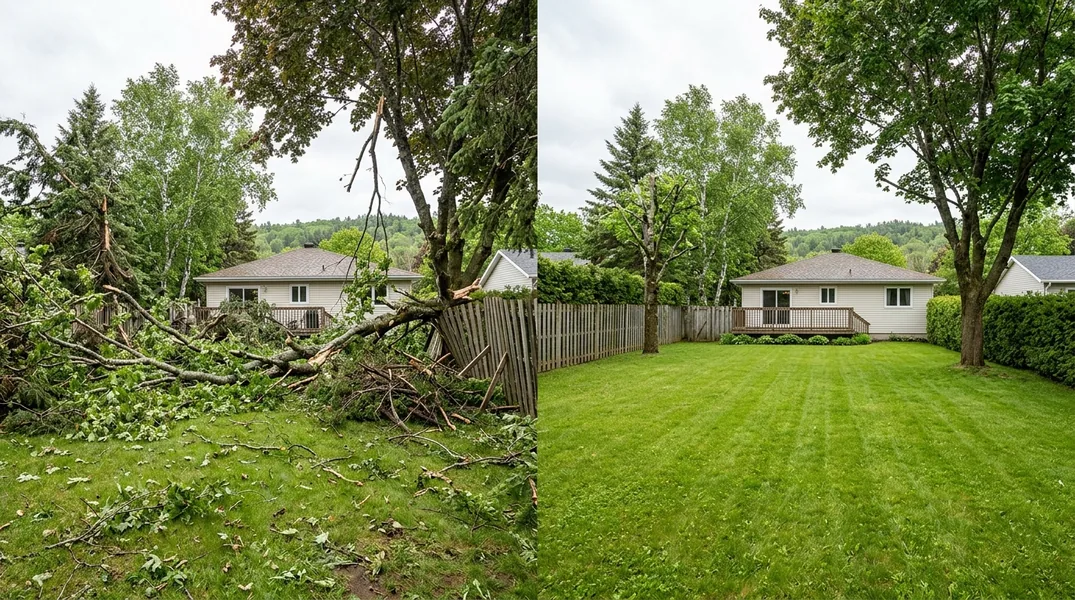
What Post-Tropical Storm Arthur Taught Fredericton About Trees
When post-tropical storm Arthur swept through New Brunswick in July 2014, it left a mark that many residents in Fredericton still remember. Winds tore through mature canopies, uprooted shallow-rooted spruce and poplar, and brought down limbs onto roofs, driveways and power lines. The cleanup took weeks, and the lesson was clear: the trees that failed were rarely the ones anyone expected. Storm damage tree removal fredericton crews handled in the aftermath revealed patterns that homeowners can act on today.
Arthur was not a one-off. The Fredericton area sits in a climate where freeze-thaw cycles, ice storms and summer windstorms are part of life. The trees that came through Arthur best were the ones that had been maintained, pruned and assessed by a qualified arborist before the storm arrived. That is the core message we share with every client: storm-proof trees are not an accident, they are the result of regular care and honest tree risk assessment.
Why Some Trees Fail and Others Stand
The damage from Arthur followed predictable patterns. Trees with co-dominant stems, narrow branch unions and included bark split under wind load. Shallow-rooted species planted in compacted soil tipped over. Limbs that had been poorly pruned years earlier, leaving stub cuts and weak regrowth, snapped first. On the other hand, trees with a single strong leader, well-spaced limbs and healthy root areas bent with the wind and recovered.
This is where professional Tree Pruning matters. Correct structural pruning removes weak unions and deadwood before a storm can exploit them. It also reduces the sail area of a canopy, which lowers the wind load on the trunk and roots. Our ISA Certified Arborists assess each tree on its own merits, looking at species, lean, soil conditions and proximity to structures. A tree that looks fine from the ground can hide decay or root damage that only a trained eye will catch.
Tree Risk Assessment: The Step Most Homeowners Skip
Tree risk assessment is the process of evaluating whether a tree poses an unacceptable risk to people or property. It is not about removing every tree that might fall; it is about making informed decisions. After Arthur, many homeowners in the Hill Area (Fredericton) discovered that a large maple near their home had a hollow trunk that had gone unnoticed for years. A risk assessment would have flagged it long before the wind arrived.
During an assessment, an arborist examines the root flare, trunk, branch structure and canopy, and considers targets such as houses, vehicles and power lines. Where decay is suspected, we may recommend resistograph testing or a climbing inspection. The result is a clear report with recommendations: prune, cable and brace, monitor, or remove. This documentation is also useful when the City of Fredericton may require a permit for a private tree removal, and an arborist report supports that application.
Preparing Your Property Before the Next Big Wind
Storm preparation starts with a walk around your property. Look for dead branches hanging in the canopy, cracks in the trunk, mushrooms at the base of the tree, and soil heaving on one side. These are warning signs that should be addressed before the next windstorm. Removing deadwood and thinning dense canopies through Tree Trimming reduces the chance of limb failure and keeps your trees healthier overall.
It also helps to think about what is under your trees. Parking a vehicle or storing a shed under a mature birch or spruce puts a target in the fall zone. If a tree is close to your home, consider cabling and bracing to support weak unions, a service our crews provide for valuable specimens. For trees that are already declining or hazardous, Tree Removal before the storm is far safer and less expensive than emergency tree removal Fredericton homeowners call for at 2 a.m. after a limb has come through a window.
When the Storm Hits: Emergency Response and Cleanup
Even well-prepared properties can suffer damage in an extreme event. After Arthur, the fallen tree cleanup Fredericton crews faced was complicated by trees resting on hydro lines and roofs. If a tree has contacted a power line, stay clear and call NB Power first. Our crews work only on clearance around the customer's private service entrance, the wire from the pole to the house, and we respect all approach distances. We never work on the public medium- or high-voltage distribution network.
For storm damage tree removal Fredericton residents need done quickly, our team prioritizes safety and access. We assess the tree, secure the site, and remove the hazard in a controlled way. Where a stump remains, Stump Grinding finishes the job so the area can be replanted or used again. We document the damage for your insurer and provide a written record of the work performed.
Rebuilding a Storm-Ready Canopy
After a major loss, replanting is an opportunity to build a more resilient canopy. Choose species suited to the local soil and climate, such as maple, oak or birch in well-drained spots, and give them space to mature. Plant away from foundations and service lines, and water deeply during the first two summers. A young tree with good structure will need less corrective pruning later.
For existing trees, a maintenance schedule is the best defence. A light prune every few years, a risk assessment for mature specimens, and prompt attention to cracks or decay will keep your trees in better shape when the next storm arrives. If you would like a professional opinion on your property, contact Fredericton Tree Trimming Co. at (506) 300-2975 or request a free estimate. Our ISA Certified Arborists serve Downtown (Fredericton), College Hill (Fredericton) and the surrounding neighbourhoods, and we are happy to review our rates with you before any work begins.
Looking for a professional in Fredericton? Fredericton Tree Trimming Co. responds quickly for all your tree trimming needs.
Get a free estimateOur services : Tree Trimming · Tree Removal · Stump Grinding