



Dead, broken and hanging branches do not wait for a convenient moment. In Fredericton, they sit above roofs, driveways and hydro service drops through every winter snow load and every summer windstorm. Our deadwood removal in Fredericton targets those limbs before gravity finishes the job. We are a local, fully insured company working since 2016, with ISA Certified Arborists on staff. Mature silver and sugar maples, red and white oaks, and ash killed by the emerald ash borer all shed deadwood at different rates, and each one needs a different approach. If you are comparing companies, start with our tree pruning service page to see how we handle live wood, then compare it with what we do with the dead material.
Why deadwood removal matters more here than most homeowners expect
Fredericton sits in a freeze-thaw cycle that opens cracks in bark and loosens limbs that looked sound in July. Add lake-effect snow and the occasional ice storm, and a dead branch over a driveway becomes a real liability by January. Ravine lots across the Fredericton area make it worse, because a limb that falls can travel farther down a slope than anyone predicts.
- A hanging branch over a roof can puncture shingles and start an interior leak with the first melt.
- Deadwood in a mature maple often hides a cavity that only shows up when the limb fails.
- Ash killed by the emerald ash borer becomes brittle fast, and the wood loses holding strength within a season or two.
- Branches over a private service entrance can rub the wire and create a hazard you cannot fix yourself.
Every one of those risks is cheaper to remove on a scheduled visit than to repair after a failure.
Key fact: a single dead limb 10 centimetres in diameter falling from 12 metres can punch through asphalt shingles and a roof deck. On a mature silver maple in a Downtown backyard, that is one of dozens of candidates we screen on a first visit.
For the official background on tree protection and private property rules in in Fredericton and the surrounding area, see the Government of in Fredericton and the surrounding area environment pages.
How our crews remove deadwood, step by step
We do not send a climber up to cut whatever looks brown. The first pass is a structural read of the whole canopy: which limbs are dead, which are dying, which are alive but badly attached. Then we plan the work around the drop zone, the service entrance and anything below that cannot be moved.
- We walk the property and mark every dead, broken or hanging limb that poses a risk to the structure, the driveway or the service drop.
- We set a drop zone and rigging plan so cut wood lands where we control it, not on a fence or a parked car.
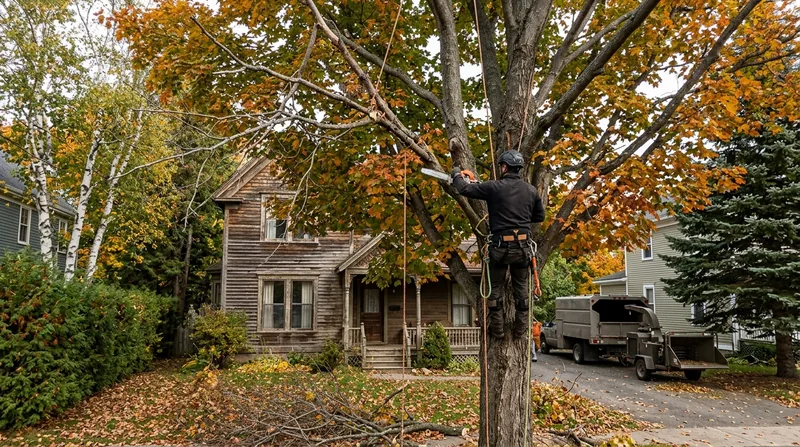
- A climber works the canopy with a pole saw or chainsaw, sectioning heavy limbs and lowering them on rope where the drop zone is tight.
- We cut back to the branch collar so the tree can seal the wound, rather than leaving a stub that rots into the trunk.
- We chip the smaller material on site and haul the larger wood away, or leave it as firewood if you ask in advance.
- We do a final walk of the roof, eavestrough and lawn to confirm nothing was left overhead.
The result is a canopy that is lighter, safer and easier to read on the next inspection.
Key fact: on a mature oak in Hanwell with a tight backyard gate, we removed 14 dead limbs in one morning using rope-lowered sections. No equipment larger than a wheelbarrow entered the yard, and the homeowner kept the larger rounds for firewood.
If the deadwood sits over a wire that runs from the pole to your house, we respect the required approach distance and plan the cut around it. For anything touching the public lines, the file goes to NB Power. See our hydro line clearance page for how that boundary works.
Methods we use, and when each one fits
Not every dead limb calls for the same technique. A hanging branch over a roof is a rigging job. A dead top in a hardwood is a sectional removal. Matching the method to the tree is what keeps the work safe and the lawn intact.
| Method | Description | Typical situation |
|---|---|---|
| Pole saw from the ground | Reach dead limbs up to about 5 metres without climbing | Small deadwood on young street trees |
| Rope and harness climbing | Sectional cuts with controlled lowering | Mature maples over roofs and driveways |
| Rigging and lowering | Heavy limbs tied off and lowered on rope | Tight backyards reachable only through a gate |
| Aerial lift access | Bucket truck where the ground allows setup | Tall canopies with clear driveway access |
| Cabling support after removal | Steel cable to stabilize a weak union left behind | Split crotches in older hardwoods |
We choose the least invasive method that gets the deadwood down safely, and we explain the choice before we start cutting.
What the work looks like in Fredericton neighbourhoods
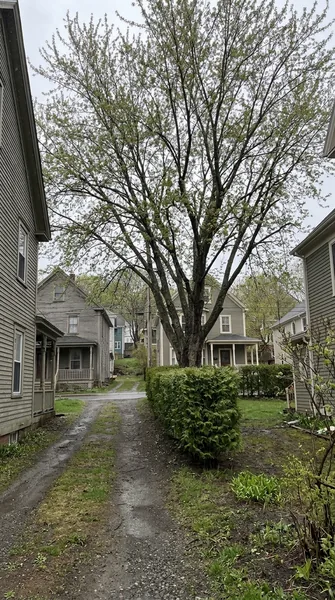
Post-war subdivisions in Fredericton have mature street trees that were planted close to houses, and the canopies have long since grown over the roofline. That geometry drives the plan: rigging over the roof, a controlled drop zone in the driveway, and a climber who knows how to work around eavestrough and satellite dishes. Ravine lots add slope, so we anchor and lower rather than drop.
We also work carefully around cedar hedges on property lines, because a dropped limb can shear a hedge that took years to grow. Tight backyards reachable only through a standard gate get hand-carried equipment and rope work, not heavy machinery. If a removal is part of the plan, the City of Fredericton may require a permit for a private tree removal, and an arborist report normally supports that application. Rules differ from one municipality to the next across the Fredericton area, so we confirm the local requirement before scheduling. Our arborist report service covers that paperwork when it applies.
Residue handling is part of the job. Smaller deadwood goes through the chipper on site, and we can leave the chips for garden use or haul them away. Larger rounds can be split and stacked as firewood if you want them, or removed with the rest of the debris. We document the work with photos before and after, which is useful if your insurer asks for evidence of a hazard you had addressed.
To see how we handle the full scope of canopy work beyond deadwood, review our tree trimming service page. For scheduling in the surrounding municipalities, check the service areas page or call (506) 300-2975.
When to book deadwood removal in the Fredericton area
Deadwood can come down any month, but the best window to schedule is late fall to late winter, while the canopy is bare and the structure is easy to read. That is also the dormancy period when trimming and structural pruning do the least damage to the tree. Ice storms and summer windstorms create emergency demand, and those calls take priority.
If you see a hanging limb after a wind event, do not wait for the next scheduled visit. Call (506) 300-2975 and describe what is overhead. For storm-related work, our storm damage cleanup page explains how we prioritize hazards. A free estimate on a calm day is always cheaper than an emergency call after a failure.
Prices Deadwood Removal in Fredericton — Indicative pricing
| Service | Price | Details |
|---|---|---|
| Deadwood removal, small tree (under 10 metres) | From $225 | Ground-level pole saw work and hand cleanup |
| Deadwood removal, medium tree (10 to 20 metres) | From $475 | Climbing, sectional cuts and on-site chipping |
| Deadwood removal, large mature tree (over 20 metres) | From $850 | Rigging, controlled lowering and full cleanup |
| Hanging or storm-damaged limb, urgent | From $350 | Priority scheduling, hazard assessment included |
| Travel | Included | In Fredericton and the surrounding area |
| Estimate | Free | Reply within 24 hours at (506) 300-2975 |
Indicative prices; free, personalized estimate within 24h at (506) 300-2975.