



A tree planting and transplanting in Fredericton starts with a simple question: what will this tree look like in thirty years, and will the space still suit it? Our ISA Certified Arborists plant and move trees across Fredericton and Hanwell, choosing hardy species for cold winters, river-valley soils and wet springs. We set every root flare at the correct depth, stake only when the site demands it, and move transplants with a full root ball. The result is a tree that establishes quickly and needs less corrective pruning later. See our tree pruning service for the follow-up work that keeps a young tree well formed.
Why planting correctly matters on Fredericton soils
Fredericton sits in a river valley where spring melt and heavy rain leave many lawns saturated for weeks. in Fredericton and the surrounding area clay holds that moisture, and a tree planted too deep in it will slowly suffocate. The same clay shrinks in a dry August, opening cracks around a root ball that was never properly firmed. Species choice matters just as much: silver maple and birch tolerate wet ground, while red oak and Norway spruce prefer a freer-draining slope.
- We test drainage before we dig, because a wet hollow in Hanwell needs a different species than a raised bed in Downtown.
- We match the tree to the mature canopy spread, not to the size of the nursery pot.
- We keep the root flare visible at grade, since buried flares are the most common cause of slow decline.
- We avoid planting ash where the emerald ash borer is active, and we explain the alternatives.
Getting these four points right at planting saves years of corrective work and usually one replacement tree.
Key fact: A 2 metre Norway spruce planted too deep in wet clay can stall for three seasons before it shows dieback. In a Hill Area backyard we replanted the same tree at the correct grade with a 1.2 metre root ball, and it put on 30 centimetres of new leader in its first full year.
For the provincial rules that frame private planting near waterways and municipal property, consult the in Fredericton and the surrounding area Department of Environment.
How we plant and transplant, step by step
Every job follows the same sequence, whether we are setting a single specimen in a front yard or moving a mature cedar hedge replacement into a new bed. The sequence protects the root system, which is where most transplant failures begin. We work around the service entrance and keep our equipment clear of the private electrical line to the house.
- We walk the site with you and confirm the planting location, sun exposure and soil drainage.
- We select the species and caliper, then schedule delivery for a cool, overcast day when possible.
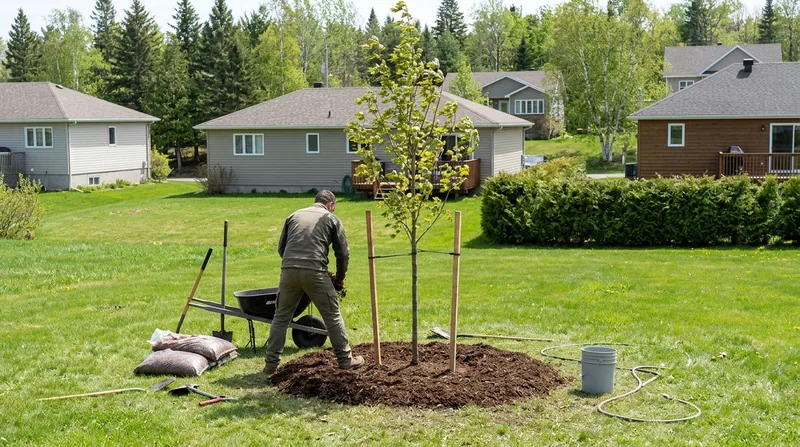
- We dig the hole two to three times the width of the root ball and no deeper than its height.
- We set the tree, backfill in lifts and water each lift to settle the soil without compacting it.
- We stake only when wind exposure or a loose root ball requires it, using flexible ties that allow movement.
- We mulch a shallow ring, keep it off the trunk, and leave you a watering schedule for the first two seasons.
Each step is documented, so you know what was planted, where it came from and how it was set.
Key fact: In a College Hill yard with tight gate access, we moved a 3 metre sugar maple by hand with a 90 centimetre root ball. The crew used a cart and plywood runners rather than a machine, and the tree leafed out normally the following spring.
If a planting plan calls for clearing an overgrown lot first, our lot clearing service prepares the ground before the new stock arrives.
Bare root, balled and burlapped, or transplanted: choosing the method
The right method depends on the size of the tree, the season and how far it has to travel. A bare root seedling suits a windbreak row on a large property, while a balled and burlapped specimen suits a front lawn where the tree must look established from day one. Transplanting an existing tree is a third option when a good specimen sits where a new driveway or addition is planned.
| Method | Description | Contexte |
|---|---|---|
| Bare root | Lightweight stock lifted without soil, planted in early spring before bud break. | Windbreak rows and large rural lots in Hanwell. |
| Balled and burlapped | Field-grown tree moved with a soil ball and wrapped in burlap and twine. | Front lawns and street-facing yards in Fredericton neighbourhoods. |
| Tree spade transplant | Mechanical spade lifts an existing tree with a full root ball for relocation. | Sites with machine access, such as ravine lots with a wide entry. |
| Hand-dug transplant | Crew digs and moves a smaller tree by hand where equipment cannot reach. | Tight backyards reachable only through a standard gate. |
We recommend the method after seeing the access, the soil and the size of the tree, not before.
Permits, clearances and cleanup around the Fredericton area
Planting rarely needs a permit, but moving or removing an existing tree to make room for new planting can. The City of Fredericton may require a permit for a private tree removal, and the application is normally supported by an arborist report. Rules and thresholds differ from one municipality to the next across the Fredericton area, so we confirm the local requirement before we schedule the work. Our arborist report service supplies the documentation a permit application usually needs.
Near the private electrical service entrance, we respect the required approach distances and keep our equipment clear of the wire from the pole to your house. Any tree touching the public distribution network is referred to NB Power, and we do not work on that network. All brush and surplus soil leave the site with us, and we chip the clean material for reuse. For a full breakdown of what a planting or transplant costs, see our pricing page.
Aftercare that decides whether the tree thrives
The first two summers determine establishment, and Fredericton summers can turn dry for weeks at a time. A new tree needs deep watering at the root ball, not a light sprinkle on the lawn. We leave a written schedule and show you how to check moisture by hand. Mulch should stay 5 to 8 centimetres deep and pulled back from the trunk. We also remove nursery stakes once the tree stands on its own, usually after the first season, because a trunk that never moves grows weak. If a young tree develops a co-dominant leader or a narrow crotch, early structural pruning corrects it cheaply.
Call (506) 300-2975 to book a site visit in Fredericton or Hanwell, or use our contact page to request a free estimate.
Prices Tree Planting & Transplanting in Fredericton — Indicative pricing
| Service | Price | Details |
|---|---|---|
| Bare root seedling planting | From $225 | Single tree up to 1.5 metres, soil preparation and mulch included |
| Balled and burlapped tree planting | From $475 | Field-grown tree up to 2.5 metres with full root ball |
| Large specimen planting | From $875 | Tree over 2.5 metres, machine assist and staking as needed |
| Transplanting an existing tree | From $650 | Hand-dug or tree spade move, assessed on site |
| Travel | Included | In Fredericton and the surrounding area |
| Estimate | Free | Reply within 24 hours at (506) 300-2975 |
Indicative prices; free, personalized estimate within 24h at (506) 300-2975.